
Types of Ecological Pyramids
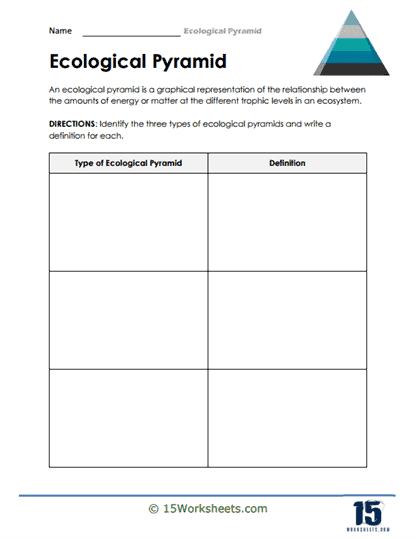
Worksheet Description
On this worksheet you will identify the three types of ecological pyramids and write a definition for each.
This worksheet provides insight into the graphical representation of relationships between the amounts of energy or matter at different trophic levels within an ecosystem. This educational tool prompts students to identify and define the three primary types of ecological pyramids. Through its structure and directions, the worksheet emphasizes the interconnectedness and hierarchy of living organisms in an ecosystem, with the pyramid serving as a visual aid to underscore the distribution of energy or matter across varying levels.
To effectively complete this worksheet, students should first conduct research or refer to their study materials to discern the three main types of ecological pyramids. Upon identifying each type, they should succinctly define them, ensuring that their definitions capture the essence of how each pyramid showcases the distribution of energy, biomass, or numbers of organisms. As they engage with this exercise, students will not only be recalling information but also honing their ability to define and differentiate between complex ecological concepts.
The primary educational goal of this worksheet is to deepen students’ comprehension of ecological pyramids and the significance they hold in understanding ecosystems. By identifying and defining each pyramid type, learners are encouraged to think critically about the distribution and flow of energy or matter in nature. The worksheet underscores the importance of visual representations in grasping intricate ecological concepts, fostering an appreciation for the delicate balance that exists within our environment. Through this activity, students are equipped with foundational knowledge that is pivotal for advanced ecological studies.
The three types of ecological pyramids are:
1. Pyramid of numbers – This type of ecological pyramid represents the number of organisms at each trophic level of a food chain. In this pyramid, the number of organisms decreases as you move up the food chain. The base of the pyramid represents the primary producers, while the top represents the apex predators.
2. Pyramid of biomass – This type of ecological pyramid represents the total biomass (i.e., the total dry weight) of all the organisms at each trophic level of a food chain. In this pyramid, the biomass decreases as you move up the food chain, as energy is lost to the environment in the form of heat.
3. Pyramid of energy – This type of ecological pyramid represents the amount of energy available at each trophic level of a food chain. In this pyramid, the energy decreases as you move up the food chain, due to the inefficiencies of energy transfer between trophic levels. The base of the pyramid represents the primary producers, while the top represents the apex predators.