
Creating Ecological Pyramids
Worksheet Description
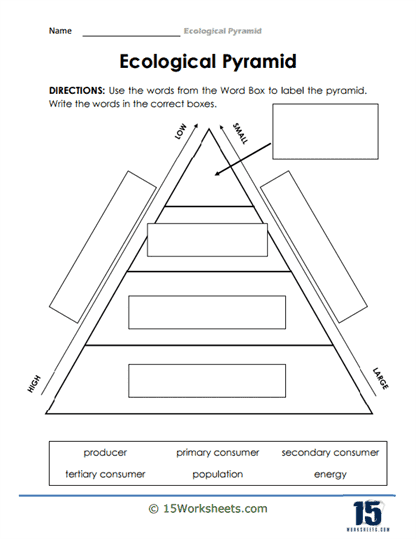
On this worksheet you will use the words from the Word Box to label the pyramid. Write the words in the correct boxes. This worksheet presents a structure that delineates the flow of energy and the number of organisms at different trophic levels within an ecosystem. Students are given a set of terms in a “Word Box,” which includes designations like “producer,” “primary consumer,” “secondary consumer,” “tertiary consumer,” “population,” and “energy.” Using these terms, they are tasked with labeling the blank spaces on the pyramid to demonstrate their understanding of ecological relationships and energy flow. The activity serves as a hands-on approach to understanding and visualizing the hierarchy and roles of various organisms within an ecosystem.
To approach this task, students should first understand the basic definitions and roles associated with each term provided in the “Word Box.” Beginning at the base of the pyramid, which represents the greatest amount of energy or organisms, they should identify the foundational producers of an ecosystem. As they move upwards, they’ll label the boxes in descending order of trophic levels, from primary consumers to tertiary consumers. The terms “population” and “energy” can be used to label the axes, delineating the two dimensions the pyramid represents.
The worksheet aims to cultivate students’ comprehension of the fundamental principles underpinning ecological pyramids, emphasizing the energy flow and decreasing population as one ascends the trophic levels. Through this exercise, learners become familiar with key ecological terminologies and the hierarchical relationships of organisms in nature. The visual representation of the pyramid underscores the concept that energy decreases while moving up the trophic levels due to energy loss at each step. Furthermore, the activity encourages students to think critically and apply their theoretical knowledge to a practical, visual scenario, fostering both retention and application of the material.