
Complete Reference Map
Worksheet Description
This is a refence worksheet that students should have handy when exploring these concepts for the first time.
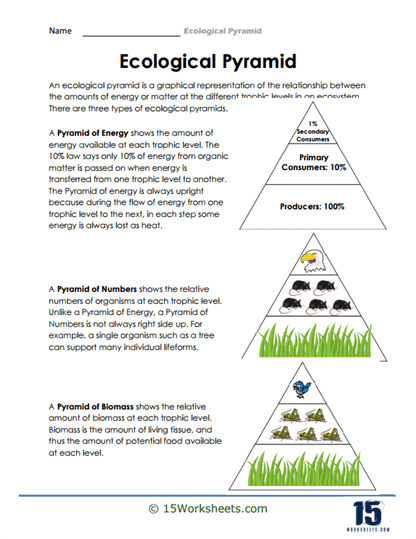
This worksheet provides a comprehensive overview of the concept of ecological pyramids, which are graphical representations illustrating the relationship between energy or matter at different trophic levels in an ecosystem. It categorizes the ecological pyramids into three main types: Energy, Numbers, and Biomass. Each type is explained in detail, highlighting their unique attributes and differences. Additionally, visual depictions accompany the text, offering a clearer understanding of how organisms are distributed across various trophic levels.
To master the concepts outlined in this worksheet, students should begin by reading the provided information attentively, ensuring they grasp the fundamental differences and similarities between the three types of ecological pyramids. They should study the visual representations to understand the distribution and flow of energy or matter across the different trophic levels. Students can benefit from taking notes or creating their own summaries to consolidate their understanding. Engaging in discussions, either with peers or educators, can further reinforce the material and allow for any clarifications or questions.
The primary objective of this worksheet is to instill in students a thorough understanding of ecological pyramids and their significance in ecology. It aims to elucidate the concepts of energy, number, and biomass pyramids, emphasizing their unique attributes and the rationale behind their structures. By explaining the flow of energy and the distribution of organisms, the worksheet seeks to offer students insights into the dynamics of natural ecosystems. The ultimate goal is for learners to be able to differentiate between the types of pyramids, understand their implications, and apply this knowledge in various ecological contexts.