
Distinguishing Dialogue
Worksheet Description
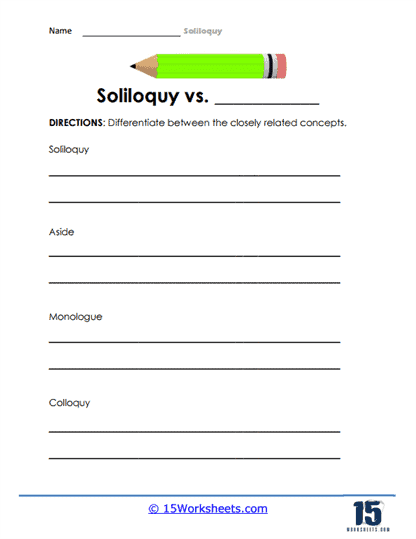
This worksheet is aimed at dissecting and distinguishing between various forms of speech commonly used in drama – soliloquy, aside, monologue, and colloquy. Students are provided with spaces to define each term, thereby sharpening their understanding of these closely related but distinct concepts. By comparing and contrasting these dramatic devices, the worksheet assists learners in grasping the nuances of theatrical language. It serves as a foundation for recognizing the methods playwrights use to develop characters and advance the plot.
The worksheet is designed to teach students about the specific roles that different forms of dialogue and presentation play within the structure of a play. It encourages them to understand a soliloquy as a character’s internal dialogue expressed aloud, an aside as a brief remark to the audience that other characters don’t hear, a monologue as an extended speech by one character, and a colloquy as a conversation between characters. This exercise aims to enhance students’ literary analysis skills by enabling them to identify and categorize dialogue types in both reading and performance. Furthermore, it helps to deepen their appreciation of the playwright’s craft in using these devices for dramatic effect.