
Concepts in Acids and Bases
Worksheet Description
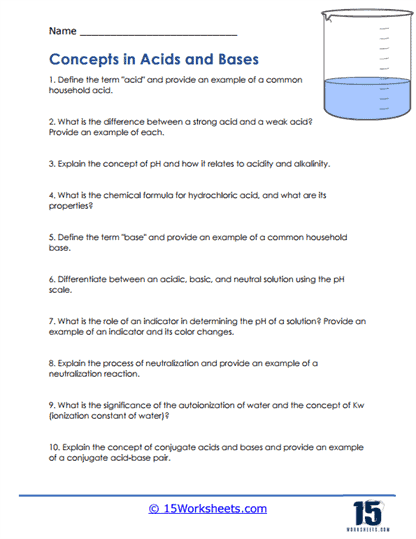
The worksheet works on foundational concepts related to the behavior, characteristics, and interactions of acids and bases. It’s designed to provide learners with a comprehensive understanding of the key principles underlying acid-base chemistry.
This worksheet aims to:
Enhance understanding of the definitions, characteristics, and interactions of acids and bases.
Equip learners with knowledge of fundamental acid-base concepts, enhancing their ability to engage with more advanced topics in the future.
Using pH charts, color indicators, and molecular structures can be beneficial in visualizing and comprehending the concepts better.
Regularly revisiting these concepts and practicing with varied questions can reinforce understanding and retention.
Concepts
Acids and Bases – Acids release hydrogen ions (H+) when dissolved in water, while bases release hydroxide ions (OH-). The presence of these ions influences a solution’s pH level.
pH – It’s a logarithmic scale that measures the acidity or basicity of a solution. A lower pH indicates acidity, a pH of 7 is neutral, and a higher pH signifies basicity.
Strong and Weak Acids/Bases – This classification is based on the degree of ionization. Strong acids/bases ionize completely in water, while weak ones only partially.
Neutralization – A reaction between an acid and a base, resulting in the formation of water and a salt.
Conjugate Acid-Base Pairs – When an acid donates a proton (H+), it becomes its conjugate base, and when a base accepts a proton, it becomes its conjugate acid.