
Ions and Ion Formation
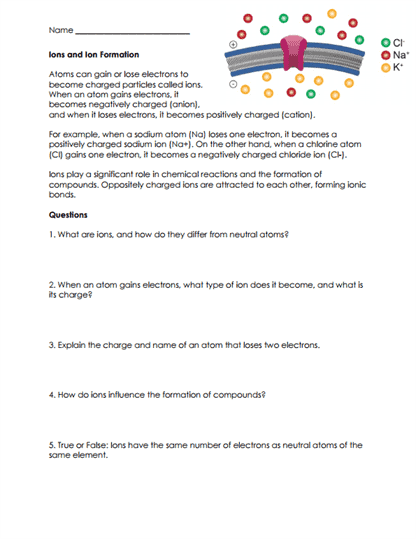
Worksheet Description
The worksheet offers a detailed exploration into the behavior of atoms when they either gain or lose electrons, consequently forming charged particles known as ions. It differentiates between atoms that become positively charged (cations) and those that turn negatively charged (anions). Through specific examples, like that of sodium and chlorine, the worksheet elucidates the transformation of neutral atoms into ions. The questions provided aim to gauge the students’ comprehension of the subject matter and assess their grasp on the formation and characteristics of ions.
To effectively navigate this worksheet, students should commence by thoroughly reading the information about ions, ensuring they grasp the differences between cations and anions. The accompanying diagrams provide visual context, assisting in the conceptual understanding of how electrons are either added to or removed from atoms, thus leading to ion formation. After grasping the foundational concepts, students should turn their attention to the questions, using the provided content as a guide to formulate accurate responses. If in doubt about a particular topic, they should circle back to the main content, reaffirming their understanding before attempting the question.
The main instructional objective of this worksheet is to instill in students a clear understanding of ions and the processes leading to their formation. By delving into the differences between cations and anions, students learn the nuances of how atoms can either gain or lose electrons, transforming their neutral states. The worksheet also illuminates the significance of ions in chemical reactions and their pivotal role in crafting ionic bonds and compounds. With this foundational knowledge, students are equipped to tackle more advanced topics in chemistry, all the while gaining an appreciation for the dynamic behavior of atoms.