
Comparing With Counterparts
Worksheet Description
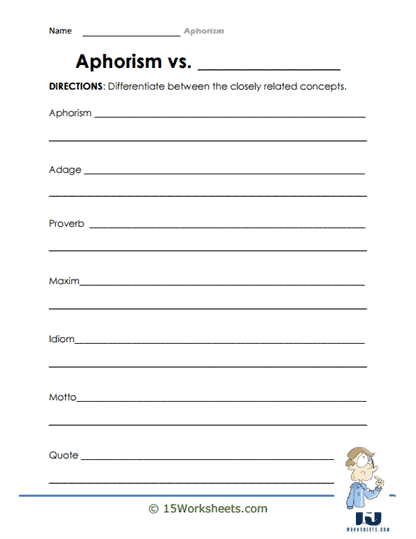
This worksheet presents an intriguing challenge for students to delve into the subtle differences between aphorisms and their related linguistic counterparts. Students are prompted to define and distinguish between six concepts: aphorism, adage, proverb, maxim, idiom, and motto. This exercise not only expands their vocabulary but also sharpens their understanding of how similar expressions can serve different purposes or convey distinct nuances in communication.
In the first part of the exercise, students must articulate what an aphorism is-a concise statement that expresses a truth or insight-and then proceed to differentiate it from an adage, which is often a traditional saying that embodies a common, practical truth or observation. They will contrast both these terms with a proverb, a short, common saying or phrase that imparts wisdom or advice. Students will also consider maxims, which are similar to aphorisms but usually carry a moral message, idioms, which are phrases with figurative meanings different from their literal meanings, mottos, which are phrases that represent the guiding principles or intentions of an individual or group, and finally quotes, which are exact repetitions of someone’s words. This task encourages critical thinking and precise comprehension regarding how language encapsulates and conveys complex ideas in various forms.