
Atomic Models Through History
Worksheet Description
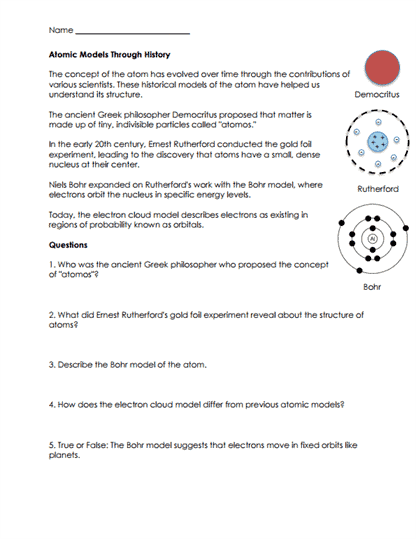
The worksheet delves into the evolution of the atomic model, highlighting the significant contributions made by various scientists over time. It traces the journey from Democritus’s ancient proposition of tiny, indivisible entities named “atomos” to the sophisticated models of the 20th century. Key experiments and theories, such as Rutherford’s gold foil experiment and Bohr’s model of the atom, are spotlighted to showcase the pivotal shifts in our understanding of atomic structure. Complementing the narrative are pertinent questions aiming to test the reader’s comprehension of the historical development of atomic theory.
To proficiently navigate this worksheet, students should begin by meticulously reading the provided content, noting the progression of atomic theories and the respective contributions of each scientist. The accompanying illustrations serve as visual aids, reinforcing the textual descriptions of each atomic model. Once the historical trajectory and significant details are grasped, students should transition to the questions, drawing upon the main content as a reference to derive their answers. Rereading specific sections might be beneficial if any query poses a challenge, ensuring a comprehensive understanding before formulating a response.
This worksheet aspires to acquaint students with the historical progression of the concept of the atom, emphasizing the iterative nature of scientific discovery. By showcasing various atomic models, from the rudimentary to the refined, it underscores the cumulative efforts of multiple scientists across eras, culminating in our current understanding. The worksheet further seeks to foster an appreciation for the scientific method, where experiments, observations, and subsequent hypotheses continually refine prevailing theories. Through this historical lens, students gain insights into the dynamism of scientific thought, recognizing that our understanding of the world is constantly evolving based on new discoveries and interpretations.