
Chemical Reactions and Balancing Equations
Worksheet Description
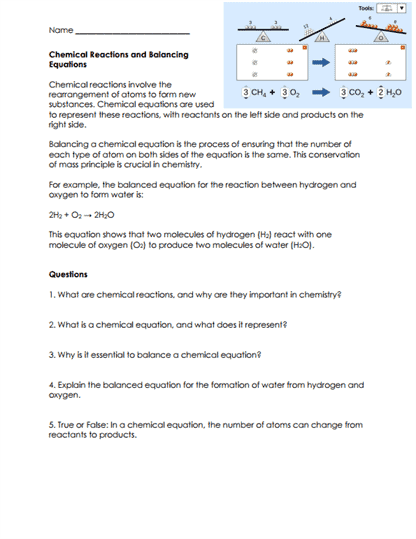
This worksheet explains that chemical reactions lead to the rearrangement of atoms, resulting in the formation of new substances. These reactions are represented using chemical equations, where reactants are shown on the left side, and the resulting products are illustrated on the right. A highlighted example provided is the reaction between hydrogen and oxygen to form water.
To adeptly balance a chemical equation, one must ensure that the number of each type of atom on both sides of the equation is identical. This process is rooted in the conservation of mass principle, which states that matter is neither created nor destroyed in a chemical reaction. As illustrated with the formation of water, two molecules of hydrogen react with one molecule of oxygen to yield two molecules of water. Ensuring this balance guarantees the accurate representation of the reaction and maintains adherence to the foundational principles of chemistry.
The core intention of this worksheet is to impart knowledge about the significance and method of balancing chemical equations in the study of chemistry. It underscores the fact that chemical reactions involve a reshuffling of atoms, which is best depicted through chemical equations. By working through the content and questions, students will comprehend why it’s imperative to balance these equations and how doing so reflects the conservation of mass. The worksheet aims to solidify this understanding, ensuring students can represent chemical reactions accurately and recognize the importance of balanced equations in conveying reaction dynamics.