
Grouping Elements
Worksheet Description
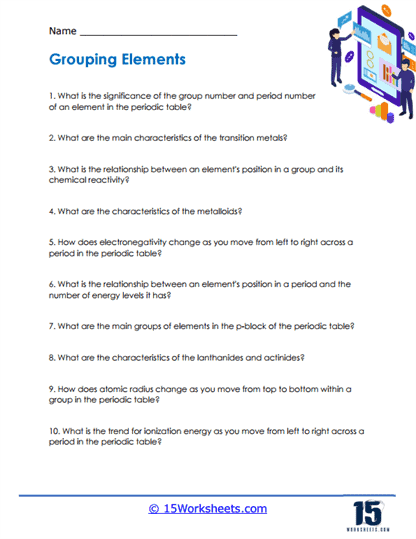
The worksheet works on the intricacies of the Periodic Table, emphasizing the importance of group and period numbers in understanding the nature and behavior of elements. It explores the distinctive properties of transition metals and metalloids, analyzes how electronegativity and ionization energy vary across periods, and considers the relationship between an element’s position and its chemical reactivity. Additionally, it sheds light on the characteristics of lanthanides, actinides, and the main groups of elements found in the p-block. The questions aim to provide a comprehensive view of the ways elements are grouped based on shared attributes and behaviors.
To effectively tackle the concepts introduced in this worksheet, students should start by familiarizing themselves with the layout of the Periodic Table and the significance of group and period numbers. Knowledge about the defining characteristics of transition metals, metalloids, lanthanides, and actinides will be instrumental. Furthermore, understanding the trends and patterns, like changes in electronegativity or ionization energy across a period, will be pivotal. A firm grasp on the relation between an element’s position on the table and its inherent chemical and physical properties will also be crucial in addressing the queries.
This worksheet seeks to impart a comprehensive understanding of how elements on the Periodic Table are grouped and classified based on shared traits and behaviors. Through its queries, it aims to solidify the student’s grasp on the significance of group and period numbers and how they influence an element’s properties. By examining specific groups, such as the transition metals or the p-block elements, it offers insights into their unique attributes. The overarching goal is to enable students to discern patterns and relationships on the Periodic Table, empowering them to predict and comprehend the behaviors of elements based on their grouping.