
The Crucible
Worksheet Description
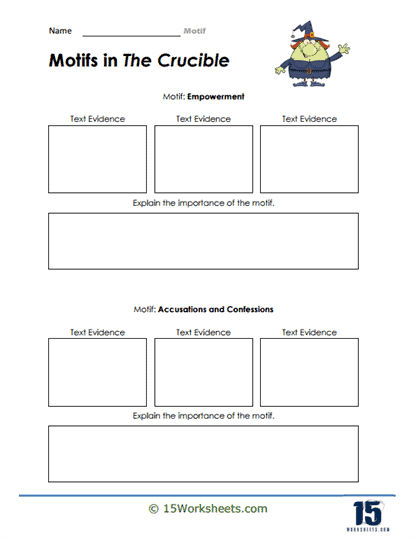
The “Motifs in The Crucible” worksheet is designed to guide students through the process of identifying and analyzing recurring motifs in Arthur Miller’s play “The Crucible.” The worksheet focuses on two specific motifs: “Empowerment” and “Accusations and Confessions,” both of which are central to the play’s exploration of the Salem witch trials and their implications.
The first section of the worksheet is dedicated to the motif of empowerment. Students are instructed to find text evidence that demonstrates how various characters either gain or lose power over the course of the play. The space provided for explaining the importance of the motif invites students to reflect on how empowerment dynamics affect the plot and the characters’ fates, as well as the broader themes of authority, integrity, and hysteria.
The second section centers on the motif of “Accusations and Confessions.” Here, students must cite parts of the text where characters accuse others or confess to witchcraft, often under duress or with ulterior motives. Students will discuss the significance of these motifs in relation to the historical context of the play and the moral and social hysteria that Miller critiques. By completing this worksheet, students enhance their understanding of how Miller uses these motifs to comment on the nature of power and the human condition.