
Positive, Neutral, Negative
Worksheet Description
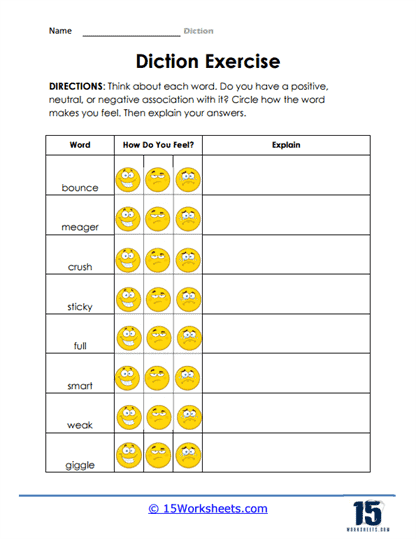
The “Diction Exercise” worksheet is designed to engage students in exploring the connotative meanings of words-how they carry positive, neutral, or negative associations beyond their literal definitions. By considering the emotional impact of words, students can better understand how diction shapes a reader’s experience and the tone of a text. The worksheet lists several words and provides a range of emoticons representing different feelings, from happy to sad to neutral. Students are asked to circle the emoticon that corresponds with how each word makes them feel and then explain their choice.
This exercise prompts students to reflect on their personal reactions to words like “bounce,” “meager,” “crush,” “sticky,” “full,” “smart,” “weak,” and “giggle.” By articulating why a particular word evokes a certain emotion, students practice analyzing language on a deeper level, considering the subtle nuances that influence interpretation. This type of analysis is critical for developing skills in literary criticism and effective writing. As students become more aware of the power of diction, they learn to choose their words more deliberately, whether they’re writing creatively, persuasively, or for academic purposes.